12 Most Prominent Symbols Of Eternity And Their Meanings
Are you looking for symbols of eternity?
Since humans have obsessed over the concept of eternity for ages, symbols have been created to represent this very concept that spans across cultures and religions.
No matter what god or gods we believe in, there is almost always a promise of eternal life.
There are different symbols depicting eternity, each with meanings that are incorporated with the beliefs about the earthly world, the afterlife, heaven and paradise, and a life that never ends after death.
Here are some of the most prominent symbols of eternity and what they mean.
12 Most Prominent Symbols Of Eternity And Their Meanings

1. Infinity Symbol

Also called a lemniscate in algebraic geometry or “lazy eight” when used in livestock branding, the infinity symbol represents the concept of eternity or limitlessness.
The infinity symbol has been around for centuries, but the symbol that we know now – a figure 8 on its side – was first used in 1655. The concept of infinity itself was documented by mathematicians and philosophers in ancient Greece.
A figure resembling this symbol is featured in early Christian iconography, while ancient Romans used a series of numerals that meant “many.”
The infinity symbol’s simple design and deep meaning have attracted many. Today the symbol is a popular sign featured in fashion and accessory design, especially in body art and jewelry.
2. Endless Knot

The endless knot is also known by other names such as eternal knot, infinity knot, mystic knot, glorious knot, and lucky knot. It is a symbol of the never-ending cycle of life, representing birth, death, and rebirth.
The endless knot is one of the most recognizable among the eight auspicious symbols of Tibetan Buddhism. It is commonly found in tattoos, rugs, and jewelry.
This knot is a single cord that is woven in and out of itself, creating a continuous loop. As the name suggests, the endless knot has no beginning and no end, something that is comparable to the cycle of life itself.
Originating in India as an emblem of Lakshmi on the chest of Vishnu, the endless knot is believed to swallow its own tail, hence, symbolizing the infinite nature of wisdom and compassion.
To learn more about this Endless knot symbol , click here
3. Celtic Eternity Knot
The Celtic eternity knot is a symbolic pattern of a looped knot without a beginning and an end. This knot resembles a maze in an overall diamond shape, with the edges often squared but may also be rounded. Symbolizing eternal life, the looped pattern goes on infinitely.
Celtic eternity knots have been used in artwork and decoration since the 8th century. Today it is more popularly used in jewelry and tattoo designs.
4. Triskele
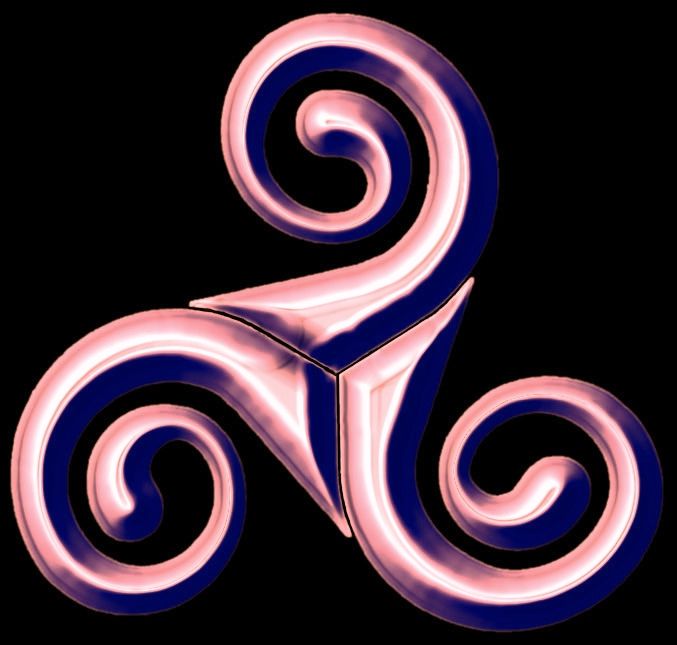
The triskele is a Celtic knot with three interlocked spirals which symbolize the tripartite in nature: earth, water, and sky. The knot itself represents the endless ribbon of eternity.
The triskele, also called triskelion, is common in Celtic knotwork. Also called triskelion, it is one of the oldest known Celtic symbols, appearing on the Newgrange kerbstones that date from circa 3200 BC.
The triskele symbol also represents the physical, spiritual, and celestial worlds. It is prominently featured in both ancient and modern Celtic art.
5. Arevakhach (Armenian Sun Cross)

The Arevakhach is the Armenian symbol of eternity. Also called the “Armenian wheel of eternity,” the Arevakhach became a symbol of Armenian identity. It is, in fact, the national symbol of Armenia.
The word Arevakhach means “Sun Cross.” This ancient Armenian symbol of eternity represents time, recurrence, and the eternal motion of life.
The Arevakhach dates back to the Bronze Age and is the most popular symbol in Armenia. If you happen by, you can see it in every corner.
As the eternity symbol in medieval Armenian culture, the Arevakhach represented the idea of endless, celestial life. It has appeared on Armenian stelae – vertical gravestones with commemorative inscriptions – since the 5th century. Later the sign became part of khachkar symbolism.
It was in around the 8th century that the use of the Arevakhach symbol had become a national iconographical practice in Armenia. The meaning has not beem changed in modern times.
The Armenian Sun Cross can also be found on church walls and other architectural monuments, as well as on Armenian manuscripts, official government and non-government logos, and commemorative coins.
6. Shen Ring

In Egyptian mythology, the shen ring is often seen carried by Horus, the falcon god. The shen ring could be used to contain other objects by stretching it. The ancient Egyptians believed that the shen ring protected the objects contained for eternity, hence, making it a symbol of eternal protection.
The word shen means “encircle.” A shen itself is a circle with a line, which is a stylized loop of a rope when represented in hieroglyphs. The knotted rope that forms an unbroken circle symbolizes infinity and completeness, and serves as protection.
When the shen ring is attached to a staff of authority (or power), as is often the case, it becomes symbolic of the eternal authority of that power.
7. Ouroboros
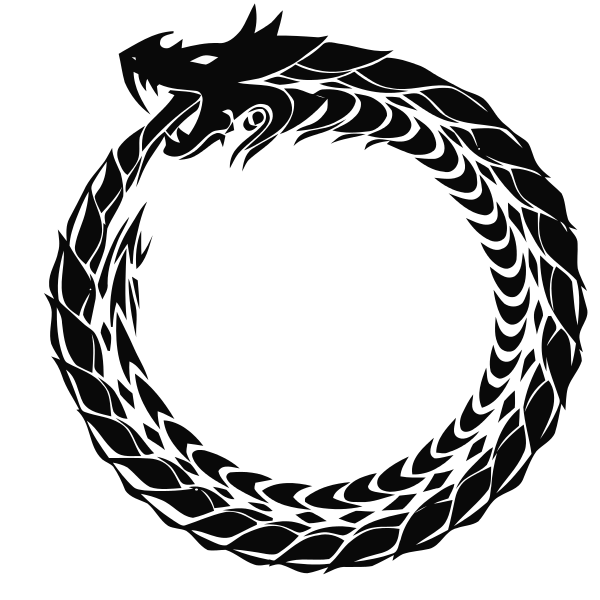
The ouroboros, also spelled uroboros, is an ancient circular symbol depicting a serpent – or less commonly a dragon – eating its own tail.
The word ouroboros, which literally means “tail-devourer” in Greek, has appeared in various forms. It is said to be the oldest allegorical symbol in alchemy.
Originally an Egyptian symbol, the ouroboros found its way to the alchemists of ancient Greece. The oldest ouroboros known appeared on a golden shrine in King Tut’s tomb in the 13th century BC in Egypt.
The symbol, referring to the mystery of cyclical time, which flows back into itself, was understood by the ancient Egyptians as a series of repetitive cycles.
The ouroboros is a symbol of wholeness and the concept of eternity. It is also used to symbolize endless return or the eternal cycle of destruction and rebirth.
To learn more about this Ouroboros symbol , click here
8. Ankh
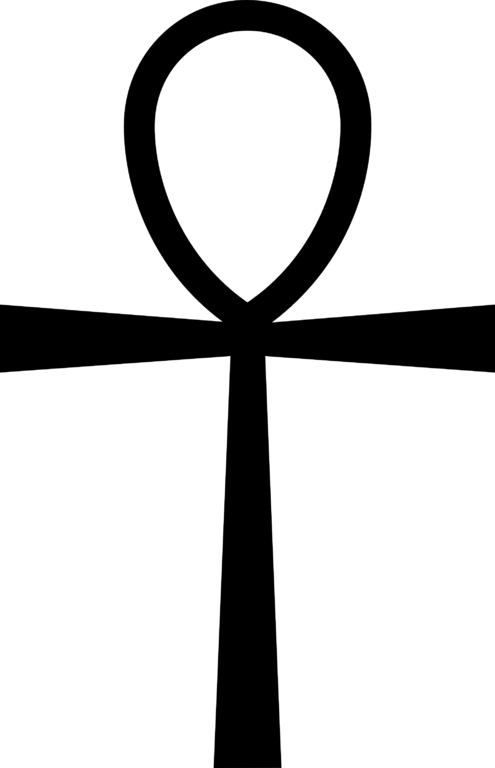
Also referred to as the cross of life, key of the Nile, or the key of life, the ankh symbol is among the most prominent Egyptian symbols. Ankh is translated as “breath of life.”
The symbol is a cross with a loop at the top. It is sometimes adorned with symbols or other flourishes but most often simply a plain gold cross. The ankh is said to be the original cross and one of the most ancient symbols of ancient Egypt, dating from the Early Dynastic Period (c. 3150 – 2613 BCE).
The ancient Egyptians believed that our worldly journey was only part of an eternal life. This eternal life is symbolized by the ankh. The symbol also represents both mortal existence and the afterlife.
The ankh is often seen paired with another ancient Egyptian symbol – the djed – and was carried by many Egyptian deities in funeral art.
Today, Egyptians commonly wear the symbol as an amulet.
To learn more about this Ankh symbol , click here.
9. Greek Key (Meander Pattern)

The Greek key is also called meander because of the line in its pattern, which repeatedly folds back on itself, resembling the ancient Maeander River in Asia Minor (the present-day Turkey).
As for the name “Greek key,” the symbol has earned it due to an individual section that looks like a primitive key.
The Greek key was a symbol for infinity and the eternal flow of things in ancient Greece. This motif is seen in the pattern’s unbroken, continuous style.
In modern times, the Greek key has come to symbolize eternity and unity due to this linear pattern.
10. Tree of Life
The tree of life is a popular eternity symbol commonly used around the world. But the symbol originated in the Middle East. It is represented by a tree with its branches and roots. Various religions and mythologies, including Christianity, Chinese, and Iranian mythology, all make use of the tree of life symbol as a symbolic element.
According to Iranian culture, the “tree of life” represents both eternity and life’s significance. On the other hand, Chinese culture believes that pairing a tree and a dragon carries a potent emblem of immortality.
The same as in the holy book of Christianity, the tree of life is said to have the power to provide immortality, and it is said that whoever consumes the fruit that grows on the sacred tree will live forever.
11. Triquetra

Three interconnected arcs with a circle at the center are what represent the triquetra or the trinity knot. It is one of the most popular Celtic knots with various meanings. The fact that the symbol has neither a beginning nor an end makes it an ideal symbol to represent eternity and unity.
However, the trinity knot symbol is also represented as the three stages of a woman’s life; the maiden, the mother, and the crone, respectively. The maiden symbolizes a woman’s youth and innocence. The mother represents maturity and maternal love.
On the other hand, the final stage is the crone that incorporates the wisdom and learnings of the maiden and mother that will be passed through their children. In addition, the triquetra is also used as religious symbolism. It is often represented as the Holy Trinity, which is why many people choose to get it tattooed.
12. Eternal Friendship
Friendship is one of the most important relationships in mankind. It is a bond between people who treat each other as family even though they are not related by blood. Chinese people, for instance, place a significant value on friendship.
The eternal friendship symbol is one of their most well-known and widely used friendship emblems. It is meant to symbolize a friendship that will last forever. The symbol has five characters wherein the first three characters symbolize eternity, and the remaining two signify the eternal bond of friendship.