8 Most Important Turkish Symbols
Are you looking for the most important Turkish symbols?
From the exquisite Turkish tea to the majestic Hagia Sophia, the cities of Ankara and Istanbul, Turkey is famous for a diverse set of both oriental and European elements. The country is also renowned for Turkish baths, Turkish delights and baklava, carpets, and bazaars. And who could forget Cappadocia?
Its rich history and even richer cultural diversity make Turkey such an interesting country that’s represented by equally interesting official and unofficial symbols.
Have a look at some of the most important Turkish symbols in the following list.
8 Most Important Turkish Symbols

1. Star and Crescent Moon

Although not official, the star and crescent moon is often seen as a symbol of the religion of Islam. It appears on the flags of numerous Muslim countries, such as Turkey where it is a very important symbol.
In pop culture, the star and crescent moon symbol is frequently employed in reference to Islam and its people, signifying the beginning as well as the end of fasting during Ramadan. However, this symbol is not officially accepted by all Muslims as an Islamic symbol.
This iconographic symbol is also used in various historical contexts. As an example, it was a very prominent symbol of the Ottoman Empire, on which the current Turkish flag is based.
Developed in Byzantium (now Istanbul) in around 300 BC, the star and crescent moon symbol became more widely used as the royal emblem of King Mithradates VI Eupator and was featured in 5th-century coins used by the Persian Sassanian Empire throughout the Middle East from the 3rd century to the 7th century.
In the Near East, the star was associated with the god Sin and the star with the goddess Ishtar. This symbol was also associated with the goddess Hecate during the early Roman period.
The star and crescent moon symbol represents power. It is especially important in Turkey where it is deemed the national emblem of the republic.
2. Flag of Turkey

The official national flag of Turkey features a red background with a white crescent moon and a five-pointed star.
In Turkey, they call this flag “al bayrak” or “the red flag.” It is referred to as “al sancak” (“the red banner”) in the national anthem.
The basic form of the Turkish national flag is derived from the late Ottoman flag which was adopted in 1793, with the five-pointed star dating to 1844. This is the final form of the Turkish flag as we see today.
The flag of Turkey is symbolic of the reflection of the moon and a star in a pool of blood shed by Turkish warriors.
The star and crescent moon serve as an emblem for Turkic peoples, with the crescent moon denoting their religious affiliations and the white star representing the diversity of Turkish cultures.
3. The Presidential Seal of Turkey
The symbol is a red seal called “the Presidential Seal,” which is made up of a sun with 16 five-pointed stars surrounding a 16-pointed sun in the center.
The sun with its 8 long and 8 short rays symbolizes the infinity of the Republic of Turkey, while the 16 stars are representative of the 16 independent great Turkic empires in history – from the Great Hunnic Empire to the Ottoman.
The Presidential Seal was adopted in 1923 and has since been used as a symbol on presidential vehicles, podiums, and other places. It is also found in official documents from the president of Turkey.
4. Seljuk Star
The Seljuk star, an ancient Turkish national symbol or tamgha (literally “stamp” or “seal”), was among the most common symbols of the Great Seljuk Empire, which was a high medieval Sunni Muslim empire that was Turko-Persian in culture. It was founded and ruled by a branch of Oghuz Turks that existed from the 14th to 15th centuries.
The Seljuk star was often featured in Seljuk architecture, carved on mosques and Islamic colleges called medrese. This symbol, consisting of two squares perpendicular to each other, has been passed down from generation to generation.
One square of the Seljuk star is a representation of the material world, while the other symbolizes spirituality or the spiritual world.
The corners of the Seljuk star represent the virtues of patience, compassion, loyalty, modesty, truthfulness, keeping secrets, gratitude, and generosity.
The octagonal star is symbolic of victory, while the eight-pointed star – which represents cardinal and intercardinal points – heralds to achieve this symbolized victory anytime, anywhere.
5. Gray Wolf

Regarded as a sacred animal in Turkey, the gray wolf is revered by the Turkish people, and also their national animal.
How this came to be roots from a Turkish legend that says the ancient ancestors of the Turks were raised by wolves. Some claim, however, that wolves aided the ancient Turks in their conquests in the very cold weather where no other animals but gray wolves can survive.
In Turkish tradition, the gray wolf is the representation of loyalty and honor, as well as spirit and guardianship.
In symbolism, gray is often considered to be a color of ambiguity and uncertainty, while the gray wolf symbolizes compassion and loyalty.
6. Nazar Boncuğu (Evil Eye)
The term “nazar” is derived from the Arabic word for “sight,” “surveillance,” “attention,” and other related concepts. “Boncuğu” or “boncuk” means “pearl.” Literally translated, nazar boncuğu means “pearl of sight.”
In English, nazar boncuğu or nazar boncuk is called “the evil eye.” This term sounds terrifying, although the real meaning is just the opposite since the evil eye is a symbol that is used to ward off evil intentions.
Found through thousands of years of history across cultures, the evil eye is depicted as 4 concentric circles that make up a figure that resembles an eye.
The evil is often worn as a necklace and sometimes as a bracelet. Because of its symbolic meaning and its use as an apotropaic amulet, jewelry featuring the nazar boncuğu has always been popular.
Hung over points of entry of a house or a building, the evil is believed to protect the place from any negative vibes that might be brought in by someone that enters.
7. Turkish Saz

Also known as bağlama, the Turkish saz is a family of string musical instruments. It is a long-necked lute used in Turkish folk music and Turkish Arabesque music, as well as the Ottoman classical. This instrument has seven strings which are divided into courses of two, two, and three.
Bağlama is from the Turkish word that means “to tie.” Saz in Persian means “to compose” or “to make.” In Turkey, the terms are used interchangeably.
In the local Islamic tradition in Turkey called Anatolian Alevism, the saz or bağlama is a powerful and sacred symbol of their identity.
8. Mount Agri
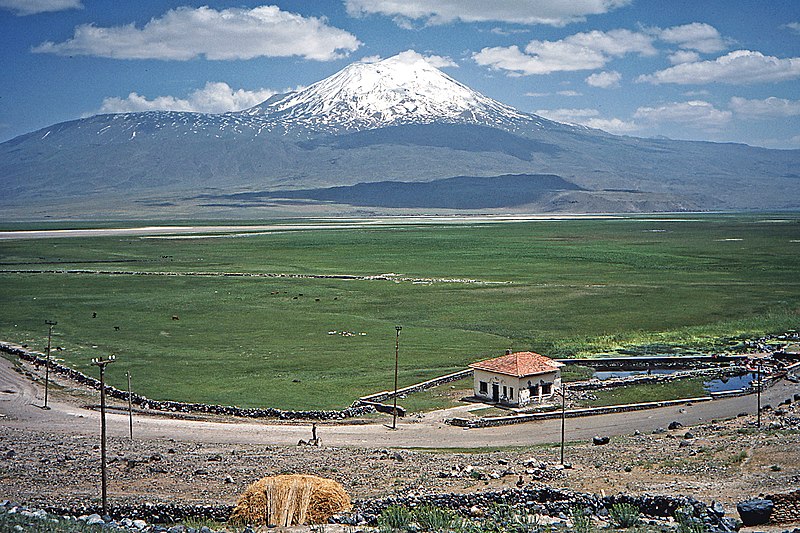
As an iconic symbol of Turkey, Mount Agri – also called Mount Ararat – is a snow-capped dormant volcano situated in the Eastern Anatolian province of Agri, near the Iranian border.
Mount Agri is the tallest peak in the country, which the summit is said to have served as Noah’s respite during the Great Flood. The wide plain of Igdir at Mount Agri’s foot is believed to be the first place where Noah set foot when the land became dry after the flood.
Mount Agri or Mount Ararat, while part of Turkey, is also one of Armenia’s national symbols.