Wheel of Taranis Symbol – History And Meaning
Known as the “Thunderer,” the Celtic god of storms and thunder Taranis held the authority over weather and, generally, the sky.
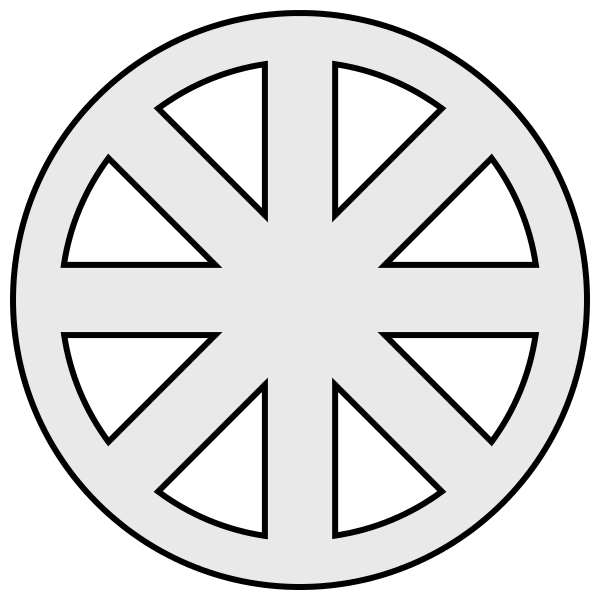
Taranis is associated with a wheel that was a significant symbolism in Celtic polytheism. Said wheel is called the “Wheel of Taranis”—or “Solar Wheel,” although it is not a symbol of the sun.
The Wheel of Taranis is sometimes erroneously called a sun cross. It is not a cross and—as already mentioned—does not represent the sun. It is linked with lightning instead.
If you want to learn more about the Wheel of Taranis symbol, read on to find out the meaning, history, and significance of this Celtic symbol.
Wheel of Taranis Symbol – History And Meaning
In Celtic mythology, the mighty god of storms and thunder traveled the world at great speeds. He used this sacred wheel to produce lightning. The wheel is believed by the Celts to spin on the cosmic axis, creating sparks that are seen as lightning.
Wheel of Taranis History

In the 1st century AD, the Roman poet Lucanus attested Taranis as the sun-, sky-, or thunder-god. Taranis was one of the three most powerful Celtic deities that the ancient Celts offered both animal and human sacrifices to. The other two were Teutates or the “God of the People,” and Esus (“Lord”).
Fallen warriors and drowned captives were sacrificed to Teutates. Esus received sacrifices in the form of prisoners who were dismembered after getting hung on trees. Taranis’ sacrificial victims, on the other hand, were burned animals or humans—prisoners, to be exact.
Taranis the Thunderer formed a sacred triad with these two other important deities, who were often found at sites bearing the Wheel of Taranis symbol.
Taranis is associated not only with the sacred wheels but with bad weather as well. He was believed to command the storms, terrifying humans. For the gods, however, he was a fierce protector and a leader—traits deemed worthy of human sacrifice.
Statues and wheels were found across Celtic Europe, depicting the worship of Taranis. However, no evidence of human sacrifice directed at him was found in these sacred sites.
Other depictions of the Taranis wheels are on coins dating to the 3rd century and other artifacts, such as the 8-spoked votive wheels, which were believed to be identified with the cult of Taranis. Gold pendants and beads bearing this symbol were also discovered in a Hungarian swamp.
The Wheel of Taranis Symbol

The Wheel of Taranis or Solar Wheel is a circle with spokes. It is a classic Druid symbol that represents a wheel, the hub of which signifies the center of the universe.
To provide the wheel—more specifically the chariot wheel—with strength, at least six to eight spokes are used. This pretty much makes the symbolic wheel sturdy enough to spin around the universe. The Wheel of Taranis symbol often used on various Celtic coins had wheels with eight spokes.
The sacred wheel and the lightning flash symbolically represented the Celtic thunder-god, although he was at times depicted riding a snake-footed beast. This depiction is said to be symbolic of divinity or some great power of unknown significance.
Wheel of Taranis Meaning
“Taranis” is derived from a reconstructed Proto-Celtic form of “Torano,” which means “thunder.” It is also cognate with the Old Irish torann, meaning “thunder” or “noise,” and the Breton and Welsh taran, which is translated as “thunderclap” or “peal of thunder.”
Taranis’ weapon was a powerful thunderbolt. His symbol, the wheel, was among the most revered Celtic symbols.
The Wheel of Taranis signified mobility, which was one of the Celtic people’s strengths. It may have also represented the quickness of a storm, catching the early humans unprepared.