The Solomon’s Knot Symbol – History And Meaning
The Solomon’s Knot is an ancient Celtic symbol representing man’s union with the Divine. Thought to date back to the Stone Age period, this symbol is one of the oldest patterns known to man. It has been used not just by the Celts but by most civilizations throughout history as well.
The Solomon’s Knot, as the name suggests, is attributed to King Solomon, as it was often seen in ancient synagogues. It is connected with the shield knot and the swastika and is frequently used interchangeably with these symbols. The Solomon’s Knot, however, is not to be confused with the Solomon’s Seal, which is a pentagram.
The Solomon’s Knot Symbol – History And Meaning
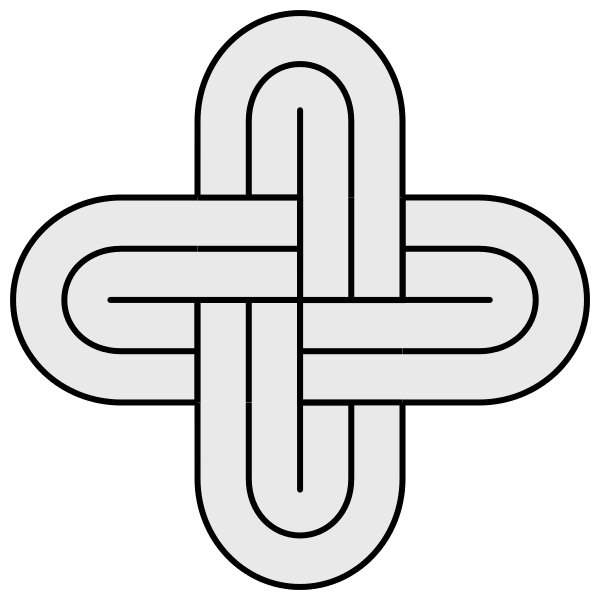
The Solomon’s Knot can also be found in ancient Roman mosaics, usually depicted as a couple of interlaced ovals. Having no beginning or end in the knot makes this symbol a representation of eternity and immortality.
The design of two interlaced figures, on the other hand, places Solomon’s Knot among the many Celtic symbols denoting love.
If you want to learn more about Solomon’s knot symbol, read on to find out the meaning, history, and significance of this Celtic symbol.
Solomon’s Knot History
Back in the Middle Ages, people used Solomon’s Knot symbols as talismans of protection from fevers. A tattoo of this pattern was believed to cure all kinds of diseases.
For centuries, the Solomon’s Knot has been employed in both mathematics and art. In modern times, a breakthrough in science occurred when chemists built a molecular Solomon’s Knot at a nanoscopic scale.
As a very old design, Solomon’s Knot was featured in many Stone Age carvings. It was commonly seen in the architecture of the ancient world as well.
This simple interlaced pattern was also frequently used in the decorations of ancient synagogues, which prompted the Hebrew King Solomon to be associated with this symbol.
But who was this King Solomon?
Solomon was a Biblical monarch, son of King David, who was probably the most famous of all Hebrew kings. King Solomon, however, was famous for being the wisest of all, which made Solomon’s Knot a symbol of wisdom.
Interlaced designs like Solomon’s Knot required great skills to make. This probably pushed this knot to become a hallmark of the Comacines, who were medieval Italian stonemasons considered as forerunners of the Freemasons. The symbol was given a mystical meaning and it came to represent eternal motion and the entwining of space and time. This is why Solomon’s Knot is also called the “Comacine Knot.”
The interlocking style of the Solomon’s Knot has led to other varying names such as the Pleter and the Frettee Cross. The Pleter, also known as the Interlaced Cross, is a popular symbol in Croatia.
The Solomon’s Knot Symbol

The Solomon’s Knot is made of a couple of closed loops, which are interlinked two times in an interlaced fashion. Laid flat, Solomon’s Knot appears to have four crosses where a pair of loops join under and over each other. A six-pointed star is at its core.
Since Solomon’s Knot apparently has no beginning or ending, it is interpreted to be symbolic of immortality and eternity. It is sometimes interpreted as a lover’s knot because of its two intertwined figures. The lover’s knot, however, is a name for another symbol.
Solomon’s Knot’s religious connections make it a symbol of faith—the union of a man and the Divine. Some, on the other hand, consider it a representation of beauty, importance, and prestige.
The Solomon’s Knot is seen in Jewish mausoleums and tombstones across the globe. In this sense, this symbol is seen as representative of eternity.
The Solomon’s Knot Symbol Meaning
The Solomon’s Knot in Latin is sigillum Salomonis, which is literally translated as “Solomon’s seal.” Thanks to his renowned knowledge and wisdom, this symbol is associated with the Hebrew King Solomon, whose name means “peace,” like the Hebrew “shalom.”
The Solomon’s Knot is a traditional decorative design that has existed for ages and used in so many cultures. But despite the name, Solomon’s Knot is classified as a link, not a true knot is defined by mathematical knot theory.
In Celtic designs, this symbol is also known as the foundation knot. This knot applies to the interlacing, which is the basis for numerous Celtic patterns.
The Solomon’s Knot Inspired Products




2 Comments