
Buddhist Symbols And Their Meanings
Looking for Buddhist symbols and their meanings? Read on to find out what these symbols mean.
Buddhism is a religion originated from India based on the teachings of Gautama Buddha. It originated from Sramana tradition between 4th and 6th centuries BCE.
Buddhism is the 4th largest religion with over 500 million followers, mostly coming from Asian countries. Although the religion originated from India, China has the biggest population of Buddhists.
Buddhism is the dominant religion of Bhutan, Myanmar, Cambodia, Hong Kong, Japan, Tibet, Laos, Macau, Mongolia, Singapore, Sri Lanka, Thailand, Kalmykia and Vietnam.
Buddhism is known as a peace and happiness loving religion which reflects to the ultimate goal of Buddhism which is to detach oneself from earthly desires and recognize the illusive and subjective nature of happiness. To simply put, be as you are, moment to moment.
Buddhist Symbols And Their Meanings
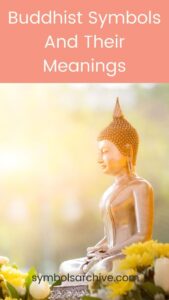
If you want to learn more about how the Buddhist symbols came to be and their significance to one of the world’s largest religions, here are the most popular symbols of Buddhism and their meanings.
Padma Symbol

The lotus flower or padma bears spiritual values across China, India, and Japan. The plant grows in the mud, although the flower itself blossoms above the water. Its petals open one by one.
In Buddhism, padma symbol is the second in the order of the Ashtmangala or the Eight Auspicious Symbols. The lotus flower comes after the endless knot and precedes the dhvaja, dharmachakra, bumpa, golden fish, parasol, and conch.
In Buddhism, the padma bloom has 4, 8, 16, 24, 32, 64, 100, or 1,000 petals. The same figures are referred to one’s body’s “internal lotuses” or what is called the chakra—the body’s energy centers.
For Buddhists, the lotus flower is representative of the purification of the body and speech, as well as the mind.
This is depicted in the lotus’ rootedness in the mud while the flowers manage to bloom on the long stalks as though they were floating above the muddy waters, which symbolize attachment and desire.
Lotus also symbolizes faithfulness. To rise above the mud the way the lotus does so it can blossom requires substantial faith in oneself. This also signifies having full faith in the teachings of Buddha.
To learn more about this Padma symbol, click here.
Bhavacakra Symbol

The bhavacakra is an intricate symbolic representation of samsara—the continuous cycle of birth, life, and death—in the form of a circle. It is the wheel that is commonly featured on the entrance wall of Buddhist temples and monasteries. The symbol has been around since the time of Buddha.
This “wheel of becoming” or the “wheel of cyclic existence” is described as the concept of rebirth or reincarnation in Buddhism. Buddhists believe that shortly after death, one’s spirit will enter an intermediate state of “bardo” or “antarabhava,” the state between death and rebirth.
The bhavacakra is a wheel commonly known as “the wheel of life” or “the wheel of becoming.” It is depicted in the Buddhist tradition as a wheel divided into six sections. These sections depict the nature of life in each of the six realms of gati or rebirth.
To learn more about this Bhavacakra symbol, click here.
Dharmachakra (Wheel of Dharma) Symbol

The dharmachakra or wheel of dharma is a major symbol of Buddhism.
The dharma wheel or dharmachakra, is the “wheel of law.” It is an ancient symbol revered by Buddhists as it symbolizes their faith, denoting the Buddha’s first sermon in a deer park at Sarnath, in Uttar Pradesh, India.
Considered one of the auspicious signs or “ashtamangala” in Hinduism and Buddhism, the pre-Buddhist dharmachakra was often used to symbolize both faiths.
From the earliest period of Indian Buddhism to the present, the wheel of dharma was frequently used as a decoration in Buddhist temples, statues, and inscriptions.
The dharma wheel is described as a chariot’s wheel that consists of the hub, the rim, and the spokes. These three elements of the dharma wheel is depicted in various ways.
The hub may be an empty circle or another wheel, as well as a yin-yang symbol, or perhaps three shapes swirling together. There are many variations of the dharmachakra, but they are usually depicted as having 8 spokes and are gold in color.
The Sanskrit word dharma is derived from the root dhṛ, translated as “to hold, maintain, or keep.” Dharma means “what is established or firm,” thus, “law.” It came from the older Vedic Sanskrit n-stem dharman-, which is literally translated as “bearer, supporter.”
To learn more about this Dharma Wheel symbol, click here.
Vajra Symbol

Vajra is a five-pronged ritual object used in Buddhist ceremonies in Tibet. Known as dorje or rdo-rje in Tibetan, varja is the symbol of the Vajrayana school of Buddhism.
The varja is a type of club made of either brass or bronze, with its four prongs at each curved around the fifth in the center, creating the shape of a lotus bud. Varjas with nine prongs are also used although less commonly.
The vajra as a symbol is used in the dharma traditions of Hinduism, Jainism, and Buddhism. It is symbolic of spiritual power and the firmness of spirit.
The vajra is a male representation symbolizing upaya or skills/skillful means. Its accompanying bell is the female symbol, denoting prajna or intelligence.
In Buddhism, vajra is the symbol of Vajrayana, one of the three main schools of Buddhism. “Vajrayana” means the “Thunderbolt Way” or “Diamond Way,” which connotes the thunderbolt experience of bodhi or Buddhist enlightenment.
To learn more about this Vajra symbol, click here.
Ajna Symbol
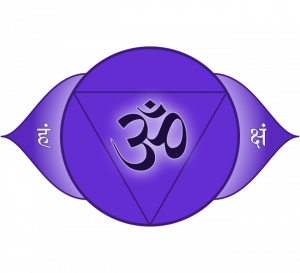
Ajna is the brow or third-eye chakra. It is the sixth primary chakra in Tantric Buddhism and some certain forms of Hinduism.
The Ajna symbol is depicted as a two-petaled transparent lotus flower. It denotes the psychic channels or nadis called Ida and Pingala. The triangle shape in the symbol and the lotus flower itself are both representatives of wisdom.
Inscribed in the right petal of the Ajna symbol is this chakra’s bija or seed syllable, KSHAM, or the more popular AUM, which is considered as the fundamental sound of the cosmos. The left petal bears the letter “ham,” written in white.
Ajna is the 6th of 7 major chakra. Ajna is also called the brow chakra or third-eye chakra, corresponding with our intuition and spiritual awareness.
It may be called the “sixth sense,” or the natural ability to know about things before others do or what others do not know.
To learn more about this Ajna symbol, click here.
Sahasrara Symbol
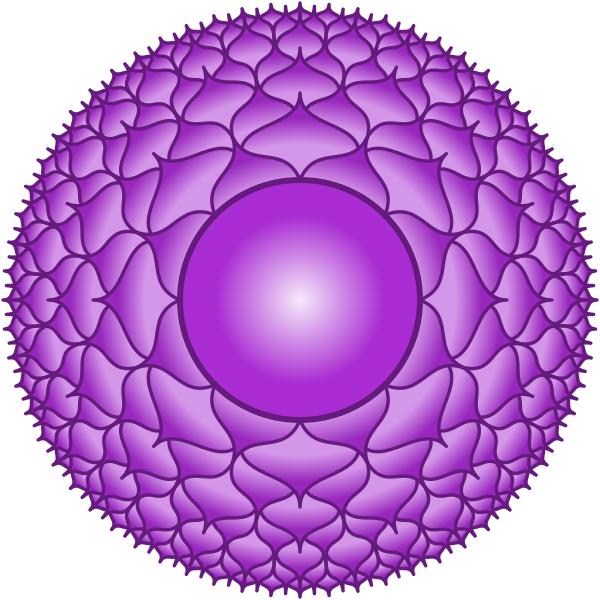
Sahasrara is the 1,000-petaled lotus symbol in Buddhist, Hindu, and other traditions. It is the symbol of the crown chakra or Sahasrara, the last of 7 primary chakras of the energy body.
Sahasrara is associated with the spiritual and higher self, emotions, divinity, enlightenment, understanding, and oneness with the cosmos. It is also linked with indescribable knowledge and the consciousness that is apart from the physical world.
Sahasrara symbol is described as a violet-colored lotus flower with 1,000 petals. These are arranged in 20 layers with 50 petals each. In some depictions, the petals are of different colors.
The lotus flower in the Sahasrara symbol has a gold-colored pericarp that encompasses around moon region with a luminous triangle inscription. This triangle is inverted in some depictions and upward-pointing in some.
Sahasrara symbol represents the opening of the spiritual self the way a lotus opens itself to the sun. The lotus flower, on the other hand, is commonly associated with beauty, purity, and renewal.


11 Comments