12 Popular Symbols Of Beauty
Do you want know some popular symbols of beauty and their meanings?
“A thing of beauty,” according to John Keats, “is a joy forever.” Others define beauty as believing in oneself and always reminding oneself that they are worth it. It is kindness to others as well as one’s own self. It is the ability to give as well as to receive love.
Beauty is self-acceptance, appreciating and loving yourself for who you are, and standing by that truth. Beauty is being the best version of yourself without apology.
If someone or something is described as beautiful, they are delightful to look at. They give pleasure to the beholder.
However, beauty is not necessarily about the outward appearance of someone or something. You can choose to see beauty in simplicity that becomes your source of joy.
Here are some popular symbols of beauty and their meanings.
12 Popular Symbols Of Beauty

1. Aphrodite
Usually depicted as a lovely young woman clad in an elegant dress and fabulous jewelry, Aphrodite is the Greek goddess of love and beauty.
Aphrodite always wears a smile on her pretty face. She has curved eyelashes and a delicate neck. No question, she has always symbolized feminine beauty.
Born out of the foam of the crystal waters of Paphos on the island of Cyprus, Aphrodite is the most beautiful goddess of Mount Olympus.
Apart from love and beauty, she is also the goddess of eternal youth and provoked desires in gods and men alike, as well as animals.
2. Mirror

Mirrors holds connotations that are both good and bad.
In spiritual symbolism, a mirror is a reflection of truth, of what is, and of who we are.
Vain people spend too much time staring at themselves in the mirror, admiring their own beauty – which makes the mirror a symbol of physical beauty as well as vanity.
3. Girdle
Merriam-Webster defines girdle as “a woman’s close-fitting undergarment often boned and usually elasticized that extends from the waist to below the hips.” In symbolism, it carries much deeper meanings.
According to Greek mythology, Hephaestus – god of blacksmiths, craftsmen, sculptors, and artisans, among others – created the girdle for his wife, Aphrodite. It was shaped like a saltire and accentuated her bossom which made her even more desirable to men.
Women have worn girdle for support or to shape their hips which has always been believed to be more attractive to the opposite sex.
While wearing girdles has lost its popularity nowadays, girdles themselves remain a popular representation of a woman’s beauty.
4. Peacock
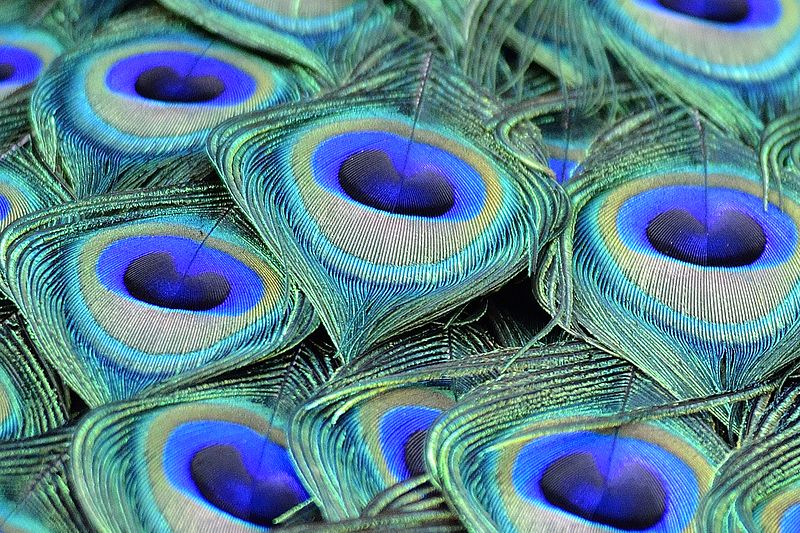
It is easy to see why the peacock has come to symbolize beauty. Of all birds that ever existed, peacocks are hands down the most beautiful.
Peacocks, like all peafowl, are originally from the Indian subcontinent. They are of stunning greenish-blue color, with yellow and golden hues. This bird has a long beautiful neck and long feathers with spots that look like little moons or eyes.
Peacocks are best admired for their feathers with prints that resemble pretty, bright moons or eyes. However, their tails are their most striking feature, signifying beauty and confidence.
Over time, peacocks came to symbolize power and royalty in various cultures. In India, their feathers are frequently compared to those of an angel.
This strikingly gorgeous fowl is a perfect epitome of beauty and sophistication, thus symbolizing them.
5. Nefer
Nefer, in Ancient Egyptian writing system, is the hieroglyph used to denote “zero.” Its symbol is represented by a heart with trachea. This hieroglyph also resembles a spoon or a lute.
The nefer symbol could mean “beautiful,” “perfect,” and “complete,” as well as “pleasant” and “good.”
The nefer symbol is popularly used as motif in Egyptian jewelry. Wearing jewelry with a nefer motif may denote good wishes to the wearer.
6. Pearl

Occurring organically, pearls are created within different species of mollusks. This makes pearls unique and very different from the rest. Other gemstones form as minerals under the earth’s surface.
Throughout history, pearls have been regarded as feminine gems. Among the myriad symbolisms of this gem, beauty and femininity have always been associated with it. Hence, pearl has become a representation of beauty and feminine energy.
Pearl also signifies purity and perfection, as well as fertility, determination, and even romance.
In ancient Rome, men also wore these gems due to their belief that pearls endowed the wearer with happiness, health, power, and wisdom. Women wore pearls for their direct link with fertility. How these gems come to be inside the oyster is as mysterious as how life starts inside a woman’s womb.
7. Color Pink

Did you know that pink used to be a masculine color? Throughout history, however, it became a woman’s color. Finally, in today’s society, this color symbol is now considered gender-neutral.
The color pink is used to symbolize not only beauty but love and compassion as well.
8. Rose

Dubbed the “queen of flowers,” rose, for many cultures, is the symbol of everlasting beauty.
All ancient cultures from Greek and Persian to Roman and Egyptian held rosebushes in high esteem because of their flowers and the products from these flowers which include aromatic rose oil and rose water.
According to Greek mythology, roses were colored by Aphrodite’s blood. The name of this flower is actually derived from the Greek word “ρόδο,” meaning “red,” since ancient roses were all red.
9. Number 6
In Roman mythology, 6 is the number of Venus (Aphrodite’s counterpart), the goddess of love and beauty.
In mathematics, the number 6 is known as the perfect number. This is because adding all the number divisors – 1+2+3 excluding the number itself – renders the sum of the number itself.
Hence, the number 6 is regarded as a symbol of beauty as well as perfection (completeness and high ideals).
Related read: Number Symbols And Their Meanings
10. Tilaka
Tilaka, which is Sanskrit for “mark,” is a mark you see generally on the forehead to signify a Hindu person’s religious affiliation.
This religious mark can be applied by hand or with a metal stamp, using materials such as clay, kumkum, sandalwood paste, red lead, turmeric, charcoal or ash from a sacrificial fire, and even cow dung.
This tradition of wearing tilaka on the forehead has been practiced for ages. It generally stands for triumph, success, and good luck. For women, it symbolizes beauty as wearing it is deemed to enhance a woman’s beauty.
11. Swan

Because of the swans’ association with deities Aphrodite and Apollo, these birds were deemed extremely important in ancient Greece.
In Greek mythology, the swan has always served as a symbol of beauty, grace, and love. For Aphrodite, the goddess of love and beauty herself, swans are sacred birds and she is frequently depicted riding one.
Swans also had the honor of pulling the chariot of Apollo, the god of art, music, poetry, and prophecy (among many others).
In literature, the swan is also seen as a representation of grace, purity and light, as well as transformation and intuition.
12. Seashell

Seashell stands for the beauty that is left behind after death, considered an eternal reminder of life’s journey and that of the soul’s afterward. It also symbolizes strength and eternity.
For people who believe in reincarnation, seashells can also denote the rebirth or resurrection of a new life.