Swadhisthana Symbol – History And Meaning
Swadhisthana is also called the sacral chakra. It is the second of the 7 main chakras in Hindu tantrism.
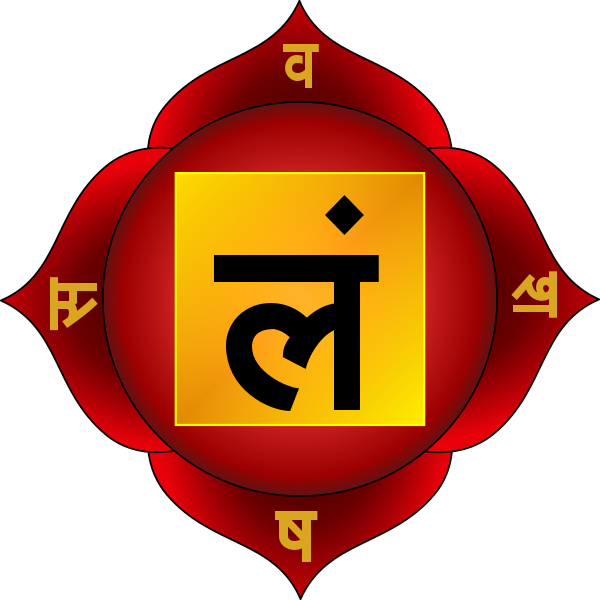
Swadhisthana is often referred to as a black lotus. The symbol is depicted in the image of a vermillion-colored flower with six petals opening from the circle in the middle. Written on each petal are the respective Sanskrit syllables ba, bha, ma, ya, ra, and la. The formation of these letters begins from the top petal moving clockwise.
There is a silver crescent moon placed within the circle, representing the Swadhisthana chakra’s tattwa (element) of water.
Swadhisthana Symbol – History And Meaning
If you want to learn more about the Swadhisthana symbol, read on to find out the meaning, history, and significance of this Buddhist and Hindu symbol.
Swadhisthana History

The chakra system originated in India between 1500 and 500 BC, first appearing in the Hindu Vedas, considered to be the oldest religious texts.
However, this was not exactly in the sense of the so-called “psychoenergetic centers” but as chakravartin. The chakravartin in this sense was the king who “turns the wheel of his empire” in every direction from the center, denoting the monarch’s power and influence. Later proofs of chakras appear in the Upanishads.
The images and symbols that are popularly used to represent the Chakras are believed to trace back to the 5 symbols of yagna. These symbols used in yagna, a Vedic ritual performed in front of a sacred fire, are “square, circle, triangle, half moon, and dumpling.”
The knowledge of the chakra system is said to be passed down through oral traditions by the Aryan people. This system was customarily an Eastern philosophy, but New Age authors started to relate with the concept and wrote about the chakras. They expanded on the earlier texts, giving more people access to the knowledge of this ancient system.
In the 8th century CE, the psychic-energy chakra theories were introduced in Buddhist texts as “hierarchies of inner energy centers.” Only four chakras appear in these texts. In later Hindu texts, the list of chakras was expanded to a lot more.
The chakra system has always been interlaced with yoga since the very beginning. But what exactly is a chakra?
The term “chakra” is from the Sanskrit cakra. which means “mystical circle” or “vortex” or “spinning wheel.” Chakra and cakra are pronounced the same way, the former being generally used in the West. Chakra refers to psychic energy centers in the lingadeha or the ethereal body.
The chakra system is prominent in the occult physiological practices of Tantric Buddhism and some certain forms of Hinduism. A chakra is a wheel of energy that runs along a person’s spine and inside the skull.
Although some claim there are as many as 114 chakras all over the body, it is generally believed that there are 7 primary chakras. These are the Muladhara (root chakra), Swadhisthana (sacral chakra), Manipura (solar plexus chakra), Anahata (heart chakra), Vishuddha (throat chakra), Ajna (third-eye chakra), and Sahasrara (crown chakra). The chakras’ health has direct links to our physical as well as mental and emotional health.
The sacral chakra is found on top of the root chakra or Muladhara which is located in the tailbone area. Swadhisthana’s corresponding kshetram or activation point is below the navel.
The Swadhisthana chakra is often associated with the tongue or sense of taste and the genitals or reproduction. It is also connected to emotions, procreation, and intimacy or desire, as well as the subconscious.
The Swadhisthana Symbol

The seed mantra of the Swadhisthana symbol is BAM, placed in the middle of the symbolic vermillion flower’s circle. Chanting this mantra is said to be capable of tapping the inner source of inspiration and creativity.
The Swadhisthana symbol is interpreted by some as the strength and energy required in order to nurture and sustain life. Its color is orange which is a mixture of red and yellow—happiness and combined.
Since the sacral chakra is connected to the element or tattwa of water, the Swadhisthana is also symbolic of flow or fluidity, movement, and being alive.
The six petals of the Swadhisthana lotus represent the attributes that we must overcome in order for us to purify the Swadhisthana. These attributes are pride, jealousy, anger, hatred, cruelty, and desire. These six petals also symbolize these vrittis: affection, cruelty, destructiveness, delusion, contempt, and suspicion.
The crescent moon in the Swadhisthana symbol denotes disorder, nonstop movement, and never-ending change.
Generally, the Swadhisthana symbol is identified with sensuality and pleasure, procreation, sense of oneself, and relationships.
The sacral chakra is linked with emotion and the unconscious. It is closely related to the root chakra in the sense that while potential karmas are inactive in the Muladhara, they are made known in the Swadhisthana.
Swadhisthana Symbol Meaning

The word “Swadhisthana” or “Svadhisthana” comes from two Sanskrit words, “swa” and “adhisthana.”
Swa is translated as “self” or “one’s own” and adhisthana means “seat” or “abode.” Hence, the word “Swadhisthana” literally means “one’s own abode. ” Or, in other words: “where your being is established.”
Swadhisthana or the sacral chakra is the second major chakra as per Hindu tantrism. Opening this chakra is said to boost creativity, manifested desire, and confidence.