Scarab Symbol – History And Meaning
Scarab is an important symbol in ancient Egyptian religion as it was linked with the divine manifestation of Khepri or the early morning sun.
The god Khepri is depicted with a scarab head and was believed to be responsible for the sunrise, rolling the morning sun’s disk over the eastern horizon at dawn.
Khepri’s name was inscribed with the scarab hieroglyph, Kheper, which embodies the ideas of existence, manifestation, effectiveness, and growth or development. It is not surprising that the scarab beetle became such a popular figure used for amulets in Egypt since the dawn of time.
The figure of a scarab was popularly used as an amulet in ancient Egypt because it was the sun god Ra’s symbol.
Scarab Symbol – History And Meaning
If you want to learn more about the Scarab symbol, read on to find out the meaning, history, and significance of this Egyptian symbol.
Scarab Symbol History

For the ancient Egyptians, the scarab beetle represented the sun. This was so because they likened this insect rolling the dung to the sun god rolling the sun to make it shine on the world.
In ancient Egyptian funerary art, the scarab was employed as a symbol of immortality and resurrection, as well as protection and transformation.
Scarab as symbols first appeared in the late Old Kingdom, but they remained rare until the Middle Kingdom. The symbol was used both as ornaments and amulets.
The ancient Egyptians believed that wearing a scarab amulet bestow protection and confidence in the knowledge of reincarnation upon the wearer.
Scarab amulets were made of various materials, but the most common was glazed steatite. Throughout centuries, the scarab was used as a form of protection by molding or carving it into amulets and accessories.
These scarabs, particularly the “heart scarabs” of the New Kingdom and later times, were placed on the breast of a mummy to symbolize the heart of the deceased. A winged scarab was also used for the same purpose. Eventually, various other scarabs were placed all over the body.
The Scarab Symbol
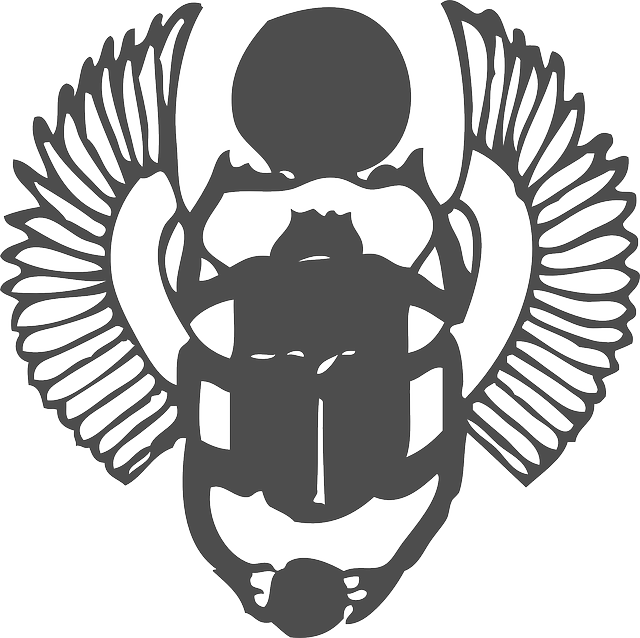
Scarab beetles were considered a lucky symbol by ancient Egyptians. A very significant symbol because it represented the sun god Ra, scarabs were popularly used as amulets in ancient Egypt.
Ancient Egyptians also revered these insects for symbolizing the circle of life and death, as well as embodying the concept of existence, growth, and development.
The scarab as a symbol is sometimes depicted with spread wings and inscripted with hieroglyphs on the flat underside.
The scarab is said to represent the sun god Ra and the divine manifestation of the early morning sun (the scarab-headed god Khepri). It also symbolizes existence, manifestation, effectiveness, and growth or development, as well as the cycle of birth, spontaneous generation, resurrection, and transformation.
The scarab symbol, when worn as an amulet, is also believed to protect the wearer from evil and provide confidence in the knowledge of resurrection.
Scarab Symbol Meaning
Scarabaeus sacer or scarab, also known as kheper beetle, is a large dung beetle native to the eastern Mediterranean area. Regarded as sacred, it was a very important symbol in ancient Egypt.
The scarab beetle lays its eggs in dung balls formed through rolling. The scarab’s life revolves around these dung balls. Scarabs consume them, lay their eggs in them, and feed their young with them – thus representing a cycle of rebirth.
When the eggs hatch, the scarab beetle seems to materialize from nowhere. Based on this observation made by ancient Egyptians, the scarab became a symbol of spontaneous generation, resurrection, and transformation.