13 Most Common Pagan Symbols And Their Meanings
Are you looking for the most common Pagan symbols and their meanings?
Symbolism is important to paganism. Proof of this is the large number of symbols used by different pagan traditions.
A good number of symbols from different cultures are also associated with paganism, representing various things and having different symbolical meanings.
These symbols serve as part of rituals in modern pagan traditions or are used in magic, as well as to represent elements or concepts.
The following are some of the most common pagan symbols we see in modern times.
13 Most Common Pagan Symbols And Their Meanings

1. Circle

The circle symbol is the most commonly seen but few are aware it is connected to paganism. Circle is important in pagan rituals such as the Wiccans’ “circle casting.”
The circle is a feminine symbol, associated with the female genitalia – the vulva or the womb. It is more often linked to nature, however, such as the earth and its shape as wells as its circular movement around the sun.
The moon, which is another important part of paganism, is circle as well. Even reincarnation is suggestive of the shape as the movement of souls between death and life is circular.
2. Kabbalistic Tree of Life
In Jewish mysticism and occult traditions, the tree of life is a mystic diagram usually comprised of 12 nodes symbolizing different archetypes and 22 lines connecting the nodes. These nodes are said to represent God, the human psyche, or the encompassing aspects of existence.
The Kabbalistic tree of life, named such to distinguish it from other concepts bearing the same name, may have been derived from the flower of life, which is an important symbol in Sacred Geometry representing the cycle of life.
3. Solar Cross

Sun worship was common in agricultural societies that relied on the sun for life and sustenance. The sun was honored and deified in many cultures for centuries.
In neopagan and Wiccan beliefs, the solar cross – also called Odin’s Cross, after one of the principal Norse deities – is symbolic of the sun, the four classical elements (water, earth, air, and fire), and the four directions, as well as the cyclical nature of the four seasons. Its association with the sun typically connects Odin’s Cross to the element of fire.
Odin’s Cross, which is a variation of the popular four-armed cross, is also employed as an astrological representation of Earth. The solar cross is often depicted with a circle in the center of the cross-arms, although not always.
The swastika is perhaps its most famous variation, originating in both Hindu and Native American symbolism. The Brighid’s Cross is another variation, which is found in Irish Celtic lands.
4. Shield Knot

The shield knot is an ancient protective symbol, believed to ward off evil spirits.
This symbol has appeared in various cultures throughout history, depicted universally as square in shape with the knotwork ranging from basic to complex. Although the shield knot can be made in different designs, its four distinct corners make it unique.
The Celtic variety of the shield knot was used on battle shields for protection and placed near sick people to ward off evil spirits and other dangers.
In modern times, the Celtic shield knot is sometimes invoked as a ward in keeping evil and negative energy away.
In other paganistic traditions, the corners of the shield knot serve as representions of the four classical elements: water, earth, air, and fire.
5. Yin and Yang

Yin and yang is the Chinese concept of good and evil, day and night, and light and dark – and one cannot exist without the other. Simply put, opposite characteristics are viewed as interconnected and counterbalancing.
The yin-yang symbol is depicted as a circle of black and white swirls, each with a spot of the other.
Yin (陰) is Chinese for “female” or “moon.” It is representative of femininity, passivity, the earth, and darkness. Yang (陽), on the other hand, means “male” or “sun” and it symbolizes masculinity, activity, the heavens, and light. This Chinese symbol is also used in New Age movement, Wicca, in the martial arts, and others.
The balance of yin and yang is viewed as having influence on health and order in an individual, the society, and the entire universe. It represents duality, or the concept that two opposite forces can actually exist in harmony and complement each other.
6. Pentacle

Pentacle, a pentagram – a five-pointed star polygon – within a circle, is used by neopagan groups alongside other magical tools in summoning spirits or certain energies.
The pentacle symbol represents the element earth and is described in old magical texts (called grimoires) as being hung about the neck and providing protection and authority to the wearer.
Despite the sound of its name, no connotation of “five” was found in these grimoires. Pentacles were rather described as magical talismans with inscriptions of symbol or character.
7. Ankh

The ankh, also called the key of life or the key of the Nile, is a cross but with a teardrop-shaped loop instead of a vertical bar on top. It is an ancient hieroglyphic symbol used in Egyptian art and writing to signify the word for “life.” By extension, it has become a symbol of life itself.
In ancient Egypt, the ankh symbolized eternal life. For pagans, the symbol is believed to mean “life to come.”
To learn more about this Ankh symbol , click here
8. Air

Depicted as a triangle shape with a horizontal line on the lower part, air is one of the four classical elements – along with earth, water, and fire – that are often invoked in pagan rituals.
Air is the breath of life and believed to be connected to the soul. It is associated with the East direction and the colors white and yellow.
9. Water
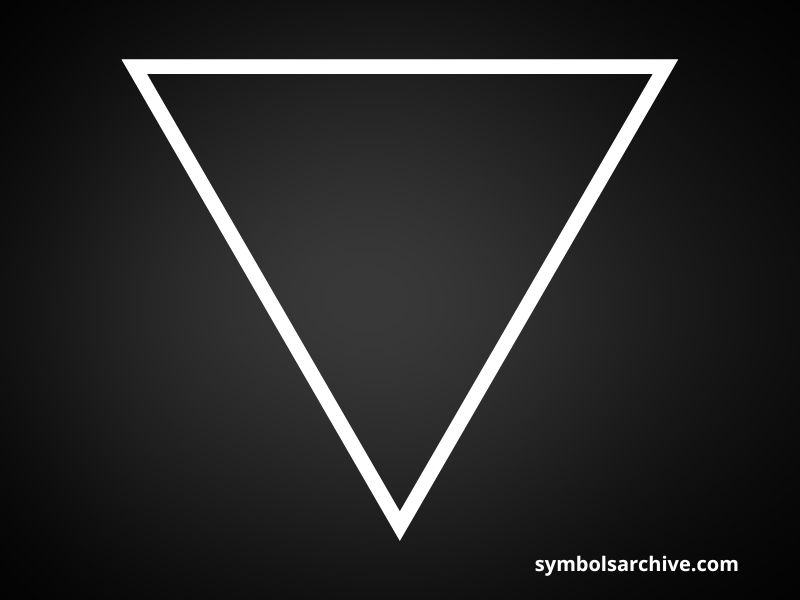
Water, depicted as an inverted triangle which resembles the shape of the womb, is considered a feminine energy in the classical elements. It is associated with the Goddess or her aspects.
In Wicca and other pagan traditions, the water symbol serves as a representation of the second degree of initiation. The symbol may also be illustrated as a series of three wavy lines or a horizontal crossbar.
10. Fire Symbol

Depicted as a triangle, the fire symbol is associated with the South. It is a purifying masculine energy and symbolizes strong will, a trait that is considered male or masculine.
11. Earth Symbol

The earth symbol is depicted as the inverted version of the air symbol.
While water is seen as a feminine symbol, earth is considered the “ultimate symbol of the divine feminine” or the giant womb which is a source of life.
12. Horned God

The Horned God is a pagan god of life cycle, nature, wilderness, virility or sexuality, and hunting. It symbolizes masculine energy and fertility.
The symbol is represented by a circular figure with a crescent on top, which is a head with horns or antlers.
The Horned God is believed by neopagans as the personification of the life force energy in animals and the wild. He is also said to carry the souls of the dead to the underworld.
13. Triple Goddess

The Triple Goddess, in many neopagan religions and spiritual traditions, is a deity worshipped and viewed as a trinity of three figures united in one being: the Maiden, the Mother, and the Crone.
Each of these three figures symbolizes both a phase of the moon – waxing, full, and waning moons – or a stage in the female life cycle. Each rules the realms of heavens, earth, and underworld and represents the Goddess of the Moon, the Earth, and childbirth.
The Triple Goddess is the goddess consort of the Horned God.