Labyrinth Symbol – History And Meaning
In Greek mythology, the legendary craftsman Daedalus designed and built an elaborate and confusing structure called the Labyrinth. It was made for King Minos of Crete for the purpose of holding the half-bull, half-man monster called Minotaur.
If you want to learn more about the labyrinth symbol, read on to find out the meaning, history, and significance of this Greek symbol.
Labyrinth Symbol – History And Meaning

The myth of the Minotaur is a story of tyranny and avarice. King Minos denied Poseidon a sacrificial bull, so the indignant god punished Minos by making his wife fall in love with a bull. The union spawned the monster, Minotaur. Shamed, King Minos locked him up in a labyrinth.
The word ‘labyrinth’ derives from the Greek labýrinthos, described as any maze-like structure that has a singular path through it.
Labyrinth History
Labyrinthine symbols date to the Neolithic Age in places like India, Ireland, Greece, and what is now Turkey. Some older Cretan coins discovered have multicursal or branching patterns, but the universal single-path and non-branching patterns are considered the classical design.
Patterns akin to the latter became widely used as the labyrinthine symbol, although in literary descriptions it is clear that the Minotaur was trapped in a labyrinth with complicated branching mazes.
The classical labyrinth symbols were used to decorate pots and baskets, carvings on caves and church walls, and even in body art. The ancient Romans made these designs in tile and mosaic. Those created in floors or on the ground were big enough for the path to be walked on.
After the excavation of the Bronze Age site at Knossos, it was suggested that the palace had been the Labyrinth of Daedalus because of the complexity of the architecture. Numerous bull motifs were also found in the site, including a depiction of a man leaping over a bull’s horns. Images of a labrys were also carved into the palace walls.
The labyrinth was used as a symbol of royal power, suggesting that the Daedalus’ labyrinth was originally the royal Palace of Knossos palace in Crete. The term ‘labyrinth’ is said to have meant “palace of the double-edged axe,” but it may not have been exclusive to the Knossos Palace because identical symbols were found in other palaces around Crete.
The Labyrinth Symbol

The term ‘labýrinthos’ came from the Minoan or pre-Greek labrys, which refers to the double ax. This is said to be the symbol of the supremacy of the Minoan Mother Goddess.
The labyrinthine symbol always accompanies women or goddesses, not male gods. Its more profound meaning is connected with the feminine life-giving force, as the center of the labyrinth is the matrix of the Goddess.
The ancient Greeks saw the bull as the zoe: the life force, the power of nature, and instincts. This very first labyrinth, apparently, was designed to guard the darkest side of nature. It symbolized King Minos’ fears as well, which were the bestial instincts that he tried to overcome.
For Native Americans, the labyrinth is symbolic of birth and rebirth. Hopi labyrinths are depicted with a cross near the center which signifies the four cardinal directions and their attributes. The spirals around this compass represent the spiral of life and creation.
The Labyrinth Symbol Meaning

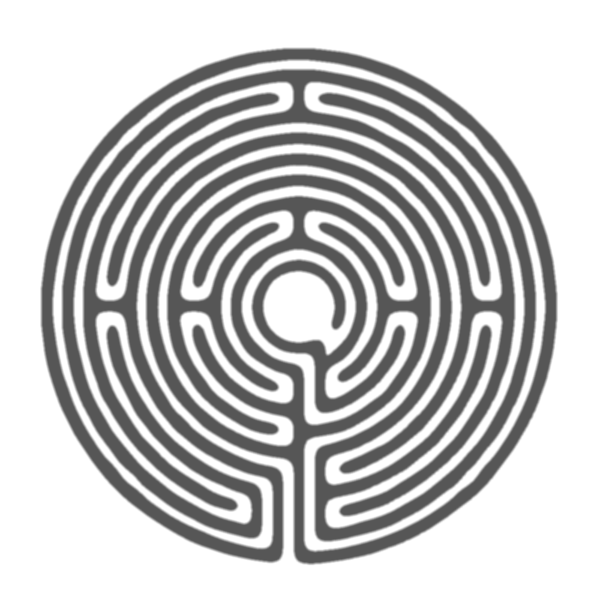
The labyrinth is defined as “a meandering path, often unicursal, with a single path leading to a center.”
Figuratively, the word means “something highly intricate or convoluted in character, composition, or construction.” Some definitions also say it is a maze. But mazes and labyrinths are distinct from each other, although they are often used interchangeably.
Here’s how to tell the one from the other:
Labyrinths have a lone continuous path that winds through it, leading to the center, while mazes have various paths striking off to different directions. With labyrinths, just keep going forward and you will get to the center; mazes, on the other hand, will not necessarily lead to it.