Symbols Of Motherhood And Their Meanings
Motherhood, according to encyclopedia.com , is “the cultural process of locating women’s identities in their capacity to nurture infants and children.”
The concept of motherhood has been around since the first humans. It transcends all races, cultures, religions, and social status. It knows no bounds. Nothing is ever greater. And its significance to all societies, then and now, is displayed through a lot of things – symbols, being among them.
Symbols Of Motherhood And Their Meanings

Here’s a list of some of the most enduring symbols of motherhood and their meanings.
1. Lakshmi Yantra
The Lakshmi Yantra symbol is common to the Hindu culture. It symbolizes purity. The goddess Lakshmi is the personification of joy, striking beauty, grace, splendor, charm, light, and fortune. She is the mother of goodwill.
Lakshmi Yantra lives in a lotus and is represented by a golden form with a golden garland ornament. According to legends, the goddess Lakshmi first sprang up from the ocean, carrying a lotus in her hand. Hence, Lakshmi Yantra is associated with the lotus flower.
“Yantra” is the Sanskrit word for “symbol” while “Lakshmi” – the name of the Hindu goddess – is derived from “Lakshay,” which is Sanskrit for “aim” or “purpose.”
2. The Circle

While perhaps among the simplest-looking of all symbols, the circle definitely is one of those with the deepest meanings. This universal symbol represents wholeness, unity, timelessness, and eternity, among others.
As a motherhood symbol, the circle represents fertility. This probably came from the concept of the roundness of a mother’s belly when she is pregnant. The circle as a motherhood symbol represents fertility.
The circle symbol is one of the oldest geometric symbols, having been around since ancient times. Called “monad” by Pythagoras, circle is the most perfect of creative forms, having no sides or corners. It neither has a beginning nor an end, thus symbolizing the never-ending cycle of birth, death, and rebirth.
3. Cow

Of all the beings that have appeared in mythologies and ancient religions, cow is among those that hold a special place. The cow – along its counterpart, the bull – is a powerful symbol. They are even venerated in some religions such as Hinduism, Jainism, Buddhism, and others.
In many cultures the world over, cows are used to symbolize motherhood, fertility, the origins of life, and generosity. The cow is also symbolic of nourishment, gentleness, and nurturing.
4. Turtle

If you ever wonder what the oldest symbol of motherhood is, it is the turtle symbol.
There is an Aboriginal legend that tells a story about how the world was created, starting with animals being masters and all living in harmony.
And then a fight occurred among the animals, angering the Creator called Kichi Manito. He sent a great flood to the earth, which was survived by just one group of animals – because they were in a canoe with the Creator’s son, Wisakedjak.
To begin the earth’s “rebirth” after long days of sailing, Wisakedjak told the animals that one of them must take a handful of soil and bring to the surface so grass, plants, and trees could grow.
After many failed attempts, a muskrat finally managed to succeed. Wisakedjak took the soil from the muskrat’s hand and put it on the turtle’s back… and that was what came to be North America that we know today.
So this legend pretty much explains why North America is turtle-shaped and why it is often referred to as Mikinak or the Great Turtle. Not surprisingly, the turtle symbol which represents the Mother Earth, is common to North American culture.
The turtle produces a lot of eggs and hatchlings at one go, thus becoming a symbol of fertility and the continuity of life.
5. The Crow Mother

In Hopi mythology, the Crow Mother is considered to be the maternal leader of all Kachinas or spirit beings represented by masked dolls. She is called Angwusnasomtaka, also known as Tümas.
“Angwusnasomtaka” means “Man With Crow Wings Tied On,” while her second name – “Tümas” – means “Crow Mother.”
The Crow Mother is said to supervise the initiation of the children into the Kachina Society and carries the yucca whips used in striking the children. This initiation rite is led by her sons, the black and blue Tüngwups. Each child receives four whippings.
The yucca is handed back to the Crow Mother when it gets worn, then she supplies a new one. After the initiatory whipping, the Crow Mother raises her skirt to receive the same whipping the children were given.
The Crow Mother symbol is represented by a doll with a crow mask. She is a figure of great dignity among the Hopi people and is seen as an ultimate symbol of motherhood.
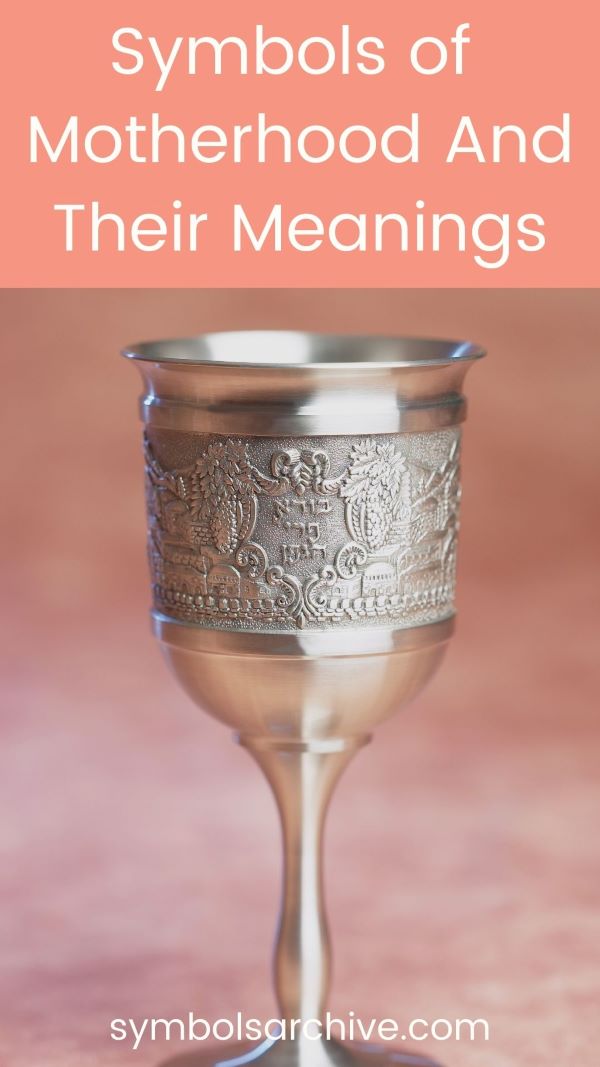
6. The Chalice

Also called The Cup, the chalice symbol resembles a woman’s womb. This is why it is considered to be the symbol of the Goddess of the Womb and the representation of the female reproductive function.
While the chalice symbol has pagan origins, it is representative of the Holy Communion in Chistianity. Chalice is the vessel that holds the wine that symbolizes the blood of Christ which, in turn, symbolizes his sacrifice for the people.
In Paganism, the chalice is a symbol of water, which is considered a feminine element. It symbolizes fertility and a woman’s intuition.
7. Triple Goddess

In Neopaganism, the Triple Goddess is a triunity of three distinct figures united as one. They are commonly described as the Maiden, the Mother, and the Crone. This is viewed as symbolic of sexuality, pregnancy, and breastfeeding.
The Triple Goddess is represented by a full moon between a waxing crescent to the left and a waning crescent to the right.
The Maiden – the waxing moon – symbolizes enchantment, inception, expansion, birth, youth, and the promise of new beginnings. The Mother – the full moon – symbolizes fertility, sexuality, fulfillment, power, and stability. The Crone – the waning moon – is representative of wisdom, repose, death, and endings.
Along with the pentagram, the Triple Goddess is one of the most prominent Neopagan and Wiccan symbols.


2 Comments