10 Popular German Symbols and Their Meanings
Are you looking for the most popular German symbols and their meanings?
Germany is a beautiful country in Central Europe that boasts a stunning landscape consisting of North Sea beaches, mountain ranges, rivers, and forests.
Germany is famous for festivals and cathedrals, castles and palaces, and of course — beer, bread, and sausages. The country is as also known for cars and free education.
Germany as a country is represented by various official and non-official symbols. These symbols represent the country’s rich culture and its over two millenia of history.
Let’s have a look at the top symbols of Germany, their history, and what they mean to the country.
10 Popular German Symbols and Their Meanings

1. Cornflower

Cornflower is a blue-violet bloom that is used as Germany’s national flower. It’s also called bachelor’s button and cyani flower (from its scientific name Centaurea cyanus). This is an annual flowering plant that’s native to Europe.
The cornflower became one of Germany’s national symbols partly due to the story about Queen Louise of Prussia fleeing Berlin when pursued by Napoleon’s forces and hiding her children in a cornflower field. As the story goes, the Queen kept the children quiet by weaving cornflower wreaths for them. After the unification of Germany, the flower came to symbolize the country as a whole.
In folklore, these beautiful blue flowers were worn by young men in love. It is said that if the flower faded quickly, it signified that the man’s love was not requited.
2. The Black, Red, and Gold Colors

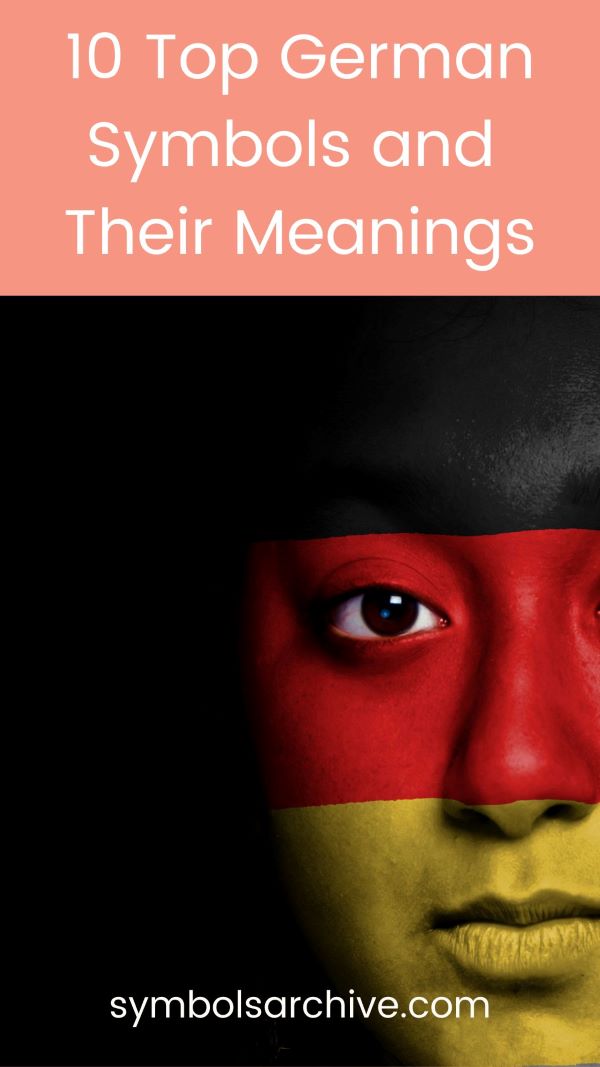
The colors black, red, and gold seen on the national flag of Germany symbolize unity and freedom. These colors were declared in Frankfurt in 1848 by the parliament to be the colors of the German Confederation. In 1949, these colors were laid down as national colors by the newly-founded Federal Republic of Germany.
The colors black, red, and gold were once used by the Holy Roman Empire, who interpreted them as: Out of the blackness (represented by the black color) of servitude through bloody (represented by the red color) battles to the golden (represented by the gold color) light of freedom.
3. Brandenburg Gate

The Brandenburg Gate in Berlin was built between 1788 and 1791. It was the first Greek revival building in the city and among the most iconic sights.
But what makes it famous is the fact that it is the sole surviving historical city gate, which came to symbolize the city’s Cold War division into East and West. It also came to represent a reunified Germany since the fall of Berlin Wall in 1989.
4. Bock Beer

Bock is a German beer that’s historically associated with special occasions in Germany, particularly religious festivals such as Christmas and Easter/Lent (“Lentenbock”).
The beer came to be known as “Bock” due to the Bavarian accent of the citizens of Munich who pronounced “Einbeck” as “ein Bock” — which means “a billy goat.” As a visual pun, a goat’s image is often featured on bottle labels.
As a symbol of better times to come, Bavarian monks brewed and drank this strong beer especially during Lenten fasts. Bock beer has been a part of many German celebrations since.
5. Federal Eagle / Black Eagle

The federal eagle — with its beak, red feet, and black feathers — is the national symbol of Germany as well as the national bird and the national animal.
The federal eagle is such a very important symbol in Germany that the Coat of Arms — called the Bundesadler, formerly Reichsadler or “Imperial Eagle” — also features this black bird on a golden background.
The black eagle (Hieraatus spilogaster) serves as a symbol of the sun, the life-force, and the highest deity. It was revered in the Orient and in antiquity by the Greeks and the Germanic tribes who regarded the eagle as the bird of the god Odin.
6. Deutscher Michel (“Michael the German”)
Originating in the first half of the 19th century, the Deutscher Michel (“Michael the German”) figure symbolizes the personification of Germany itself. It is the representatiom of the German people’s national character.
Deutscher Michel is usually depicted wearing a nightcap and nightgown, oftentimes in black, red, and gold colors. This figure represents the Germans’ concept of themselves, particularly Deutscher Michel’s easy-going nature and an ordinary man’s appearance.
The image of Deutscher Michel also symbolizes both the innocence and simple-mindedness that get exploited by foreigners, as well as the physical strength that the German Michel could utilize to fight them when roused. This symbol has been interpreted by some to have been anti-foreigners.
7. Eiserne Kreuz (“Iron Cross”)
A military decoration back in the Kingdom of Prussia, the Iron Cross — Eiserne Kreuz in German — was later used in the German Empire as well as the Nazi Germany.
This symbol, which is typically in black with a white (or silver) outline, dates back to after 1219 in the Kingdom of Jerusalem. As a military decoration, it was established by King Friedrich Wilhelm III of Prussia and first awarded in 1813.
In 1956, the Iron Cross became the symbol of the modern German Armed Forces and has been used on aircraft and armored vehicles since.
8. Germania
Appearing first during the Roman Era, Germania is a national personification symbol of Germany or the Germans as a whole.
Germania is depicted as a robust female having long, flowing reddish hair and wearing a crown of German oak leaves (which signifies heroism), broken chains (representing liberty/being freed), and ray of rising sun (which denotes the beginning of a new era).
Germania often wields the imperial sword (which is symbolic of power and readiness to fight) and has a medieval-style breastplate with the image of the federal eagle on a gold field (denoting strength). The olive branches that surround her sword represents the willingness to make peace.
9. Cuckoo Clock
The cuckoo clock is a cultural icon of Germany and among the most popular souvenirs of travelers in the country.
This timepiece has often been featured in music, literature, cinema, television, and others. It is used as a symbol of childhood and innocence, old age and the past, as well as fun and mental disorder, among others.
More than any other kind of timepiece, cuckoo clocks are intricately designed and handcrafted by master carvers in Germany. These carvers preserve the same methods of craftsmanship employed in the olden days. Those who aren’t into the historical style can also get modern-looking cuckoo clocks today.
The inventor of the cuckoo clock is not known. No one also knows where the first of this clock was created, but much of its development and evolution is thought to have taken place in the Black Forest area in southwestern Germany. It was where cuckoo clocks became world-famous from the mid-1850s on.
10. Oktoberfest
The German fall festival celebrating food, beer, and merrymaking is the famous Oktoberfest held annually in Munich, in the Bavaria region of Germany. This festival lasts for 16 days and features beer tents, games and music, and a traditional Bavarian fair.
Oktoberfest started on October 12, 1810, when the Bavarian Crown Prince Ludwig married Princess Therese von Sachsen-Hildburghausen, and all citizens were invited to the wedding feast.
Oktoberfest is the world’s largest celebration of Bavarian culture, but it has come to represent the whole German culture to the world as well. As the largest folk festival in the world, Oktoberfest attendees — over 5 million people from all corners of the world — consume over 7.5 million liters of beer.
This significant German event is as symbolic as it is historical. Oktoberfest embodies the significance of German beer garden culture in creating a sense of community.
German beer garden culture in creating a sense of community.