Cartouche Symbol – History And Meaning
Cartouche is an important ancient Egyptian symbol, representing the king’s power over the universe.
It is a hieroglyphic symbol with an oval that signifies a rope and a horizontal line that symbolizes the rope being tied together at the bottom to create an encompassed loop. It was an extended version of the shen ring which was a circled hieroglyph.
For the ancient Egyptians, the circular rope denoted everything enclosed by the sun, which signified the king’s power over the universe.
Cartouche Symbol – History And Meaning
If you want to learn more about the Cartouche symbol, read on to find out the meaning, history, and significance of this Egyptian symbol.
Cartouche Symbol History

The term “cartouche” was first used by French soldiers who thought that this symbol looked like a cartouche, French for a specific gun cartridge or bullet.
When Napoleon took his army to Egypt, the soldiers saw this hieroglyph and, seeing the resemblance to a particular gun catridge, decided to call it “cartouche.”
In ancient Egypt, cartouche was a hieroglyph the Egyptians used to distinguish the names of kings or pharaohs from other writings and hieroglyphs. This has been interpreted as a form of respect.
The Egyptians wrote the cartouche horizontally when a deceased pharaoh’s name was too long. This hieroglyph signified that anything appearing inside it came from Egyptian royalty.
The first examples of these cartouches are linked with pharaohs at the end of the Third Dynasty. However, the feature became prevalent only at the beginning of the Fourth Dynasty.
Because the names of the pharaohs were written within their respective cartouches, none of them looked the same. Each pharaoh had his own cartouche inscribed in his tombs and belongings.
The ancient Egyptians believed that this practice helped the deceased rulers in their journey to the netherworld and their names would not disappear after death.
Archaeologists often excavate artifacts that are used in dating a tomb. Some of these items are amulets in the form of a cartouche with a royal name in it. These were placed in tombs and were exclusively worn by paharaohs. It was believed that the oval that enclosed their name would protect them from evil spirits both in life and after death.
However, evidence suggests that ordinary Egyptian people also used cartouche in their amulets for protection in later years. It has become a symbol of good luck and protection from evil since.
The Cartouche Symbol
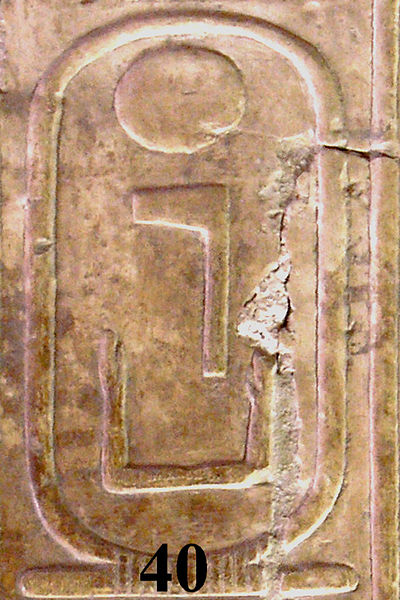
The cartouche symbol is represented as an oval placed vertically, with a horizontal bar at one end. Cartouches could also be horizontal, depending on the length of a royal name written inside it.
This oval-shaped symbol bears hieroglyphs in the center and a line underneath. The circle around the hieroglyph stands to for a magical rope and the bar beneath signifies the place where the rope is tied together. The rope circle symbolizes everything being bound by the sun which represented the king’s power over the universe.
Cartouches were solar symbols, denoting the powers of the sun, with its oval form said to symbolize the shape of the sun.
Cartouche was also seen as possessing the ability to protect the kings or pharaohs from the world’s evils. The oval shape encompassing the hieroglyphic inscription became a symbol of protection for the pharaohs. However, they later came to symbolize both good luck and protection, not just for the royals but the masses as well.
Cartouche Symbol Meaning
In ancient Egypt, the cartouche symbol was called “shen” or “shenu,” which means “encircle.” The term “cartouche” is pretty recent, having been around only since Napoleon Bonaparte’s time.
“Cartouche” is actually French for a muzzle-loading gun’s paper powder cartridge, which resembled the hieroglyph that the French soldiers had seen when Napoleon took them to Egypt.
A cartouche was a name plate for royals and other important figures back in the day. It was oval-shaped, used in order to distinguish them from other hieroglyphs.
Today cartouches are used as necklace pendants and other jewelry.



One Comment