Nataraja Symbol – History And Meaning
Nataraja is a famous symbol in India. It is commonly used to represent the Indian culture and is deemed to be among the finest of Hindu art.
The cosmic dance of Nataraja is an incarnation of Shiva as the god of dance and dramatic arts. Additionally, Nataraja performs the Nadanta as maker, nourisher and destroyer of the cosmos. In Hindu mythology, the Nadanta is said to stop the noise of the cosmos from its destruction.
Nataraja Symbol – History And Meaning
If you want to learn more about the Nataraja symbol, read on to find out the meaning, history, and significance of this Hindu symbol.
Nataraja History

Since the 12th century, Indian scholars have studied and interpreted the details in the Nataraja, not only for its symbolic meaning but its theological essence as well.
One of the earliest known artworks featuring Nataraja was discovered in the archaeological site at a village in Odisha, dating to around the 6th century CE. It includes an inscription mentioning a Shiva temple in the Saivacaryas Kingdom. Literary proofs show that the bronze sculpture of Shiva’s Ananda-Tandava was first featured between the 7th and mid-9th centuries CE.
Sculptures in reliefs featuring the classical form of Nataraja can be found in many cave temples across India.
A red Nataraja statue carved in sandstone said to date back from the 9th to 10th century was discovered in Madhya Pradesh state in Central India. It is now being showcased at the Gwalior Archaeological Museum.
Another Nataraja artwork was discovered in the Himalayan region. Here Shiva is depicted in a somewhat different iconography and dance pose.
Nataraja symbols have also been found in Kerala, Andhra Pradesh, and Gujarat.
In the medieval era, texts and symbols depicting the dancing Shiva were also discovered in the Indian states of Bengal and Assam, as well as Nepal. In these archaeological discoveries, Shiva is shown as dancing on Nandi the bull, his animal vehicle (“vahana”).
The oldest free-standing Nataraja stone sculptures to date are statues built by the Chola queen Sembiyan Mahadevi in the 10th century. This resulted in the Nataraja symbol’s great significance, becoming a royal emblem for the Chola dynasty. The dancing Shiva came to be a part of religious festivals and processions in this era, continuing long after.
The Nataraja Symbol

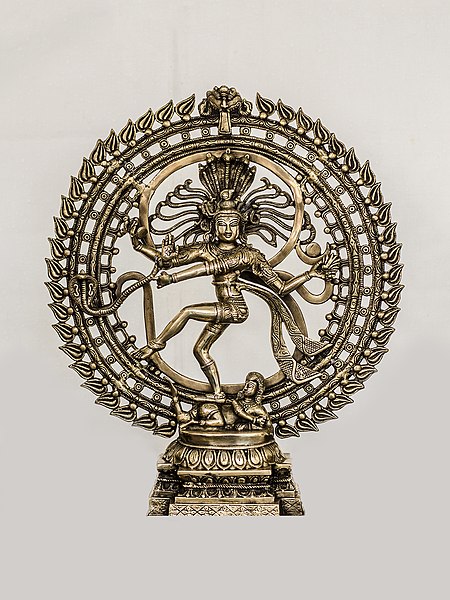
That famous depiction of the Hindu god Shiva as the divine dancer is called the Nataraja. Shiva as Nataraja or “Lord of the Dance” performs the Tandava, the very dance in which the cosmos is created, sustained and resolved.
The Tandava—“the frantic dance”—refers to Shiva’s energetic dance that he performs when he’s in a nasty mood. This is depicted in the representation of Shiva having ten arms, accompanied by his consort Devi.
Shiva dances inside an elliptical arch of flames, which denotes the cosmic fire that both creates and consumes everything in cyclical existence. The fire is also symbolic of both the evils and joys of daily life, as well as its heat, warmth, and light. The arch of fire—the prabha mandala—comes out on each end of the two mythical water beasts called the makara.
In his dance, Shiva’s legs are bent, suggesting an energetic movement. His matted long hair is illustrated as loose and whirling in thin strands as he dances, spread like a fan at the back of his head. This is suggestive of the wild and ecstatic nature of his dance.
To Shiva’s right is the personification of the Ganges River as a goddess, locked in with one of his flying hair strands near his brows. This symbolism is a representation of the danger of the mighty river connected with a calm one as the rebirth of life.
This vigorous dance with rhythmic music signifies the movements in the cosmos. The same representation goes for the ring of flames surrounding Shiva.
The dwarf upon which Lord Shiva dances is sometimes mistaken for a baby. This is actually the demon of nonsensical speech and spiritual ignorance called Apasmara, or Muyalaka in Tamil. Apasmara symbolizes the demonic evil subdued by the deity in his dance. This demonstration represents Shiva relieving the egotism or ignorance in each one of us, destroying it all within himself.
Nataraja Symbol Meaning

The word “Nataraja” is from the Sanskrit “Nata,” meaning “act, drama, or dance,” and “Raja” which translates to “king or lord.” Roughly translated, “Nataraja” means “King of dance” or “Lord of dance.” The title is said to be associated with Shiva’s fame as the “King of Actors” or “Lord of Dancers.”
The two most common forms of the Hindu deity’s dance are the gentle form called the Lasya, which is related to the creation or origin of the cosmos, and the energetic dance form called the Tandava, tied with the destruction of the world views. The Lasya and the Tandava are just two facets of Lord Shiva’s nature—he who destructs in order to create, demolishes to construct again.
The term “Natesa” is a variant for “Nataraja,” found in 1st-millennium sculptures and archaeological sites all over the Indian subcontinent.



One Comment